

Building tolling & mobility systems at scale: the technical reality
This piece covers three modern connected mobility cases: free-flow tolling, public traffic infrastructure, and access networks. What connects them is the engineering required to make complex infrastructure work reliably at scale.
Key Takeaways
Klika builds that anchor this story: A free-flow parking enforcement platform that delivers 100% revenue protection, a traffic-intelligence app launched in just 120 days, and a validation ecosystem capable of processing more than 50 transactions per minute.
Four engineering disciplines recur: governance as configuration, idempotency and audit trails as revenue infrastructure, prioritizing abstraction over replacement, and designing interoperability from the very beginning.
The same disciplines apply anywhere revenue, law, and legacy infrastructure come together. Hence, this includes road-user charging, congestion pricing, or any public-facing system that has to remain reliable at a large scale.
Contemporary tolling technology is capable of identifying vehicles traveling at highway speeds with remarkable accuracy. Advanced back-office systems can recognize license plates with greater than 99% precision. The associated sensors, cameras, and transponders are mature, widely available, and thoroughly understood.
Despite technological advancements, these systems continue to experience failures.
The primary challenge has never been the sensor itself. The true complexity lies in the processes that follow detection. Namely, converting a sensor reading into a legally enforceable charge, or maintaining consistency across jurisdictions with varying regulations. Moreover, how to integrate infrastructure that was built decades apart. These challenges are not based on hardware but on engineering discipline.
That discipline is the story. It’s what separates a system that protects every cent of revenue from one that quietly leaks, and a platform that scales across borders from one that has to be rebuilt at the next one.
What follows is a walk-through of three mobility systems we built, and the disciplines that tie them together.
When Software Is the Only Thing Standing Between Revenue and Leakage
The moment a tolling or parking operator removes the physical barrier, the economics change completely, since the gate serves as a physical fail-safe. Without this barrier, implemented to increase throughput, each unpaid session becomes a potential revenue loss that must be addressed through software solutions.
The client is a global leader in access and mobility, supporting critical infrastructure in over 100 countries, including international airports and major urban transit hubs. To modernize the Northern European parking market, the company introduced a “Freeflow” model utilizing high-speed Automatic Number Plate Recognition to eliminate physical barriers. While this approach offered significant convenience, it also introduced risks. In the absence of gates, revenue protection relied exclusively on the effectiveness of the enforcement layer, which exhibited vulnerabilities. Inadequate data grouping resulted in duplicate cases and inconsistent vehicle identification, and unreliable status transitions to external collection agencies created gaps in the audit trail.
100% revenue protection across a barrier-free enforcement pipeline
Zero duplicate enforcement cases after idempotent grouping
Multi-jurisdiction deployment with compliance handled per country
Our team re-engineered the enforcement integration layer to ensure legal defensibility. Leveraging Java (Spring Boot), Angular, and robust REST APIs interfacing with the ANPR feed, we implemented session aggregation to consolidate multiple parking events into a single enforcement case. An idempotent architecture was developed to guarantee data consistency during high-frequency calls. As a result, identical vehicle events could not generate duplicates, and all unpaid sessions were reliably captured and transferred for collection. Additionally, we designed structured logging and state-transition logic to ensure that every enforcement transfer included an audit-ready record.
In addition, the jurisdictional dimension contributed to the project’s complexity. The Nordic markets impose disparate legal requirements and strict GDPR standards on how vehicle and owner data is captured, processed, and acted upon. In response, the team developed a modular governance engine, which serves as a configurable rule-set layer that lets the client adjust enforcement logic on a per-country basis.
The result was zero duplicate cases and 100% revenue protection, on a foundation stable enough to scale the “Freeflow” model across multiple jurisdictions.
Read more about this engineering engagement →
When Decades-Old Infrastructure Has to Speak Mobile
Tolling rarely stands alone. Usually, it is a part of a larger mobility network that covers traffic management, connected-vehicle data, and urban infrastructure. Much of this infrastructure predates the advent of smartphones and was not designed to work with other systems outside its original setup.
Our client is a global leader in mobility solutions, recognized for setting standards in urban traffic management, tolling, and connected-vehicle systems. They provide critical infrastructure for governments and municipal operators across Europe, the Americas, and Asia. In order to maintain their competitive advantage in the smart-city sector, the client required a white-label mobile application capable of delivering real-time traffic intelligence and predictive navigation to commuters. Our team was selected from eight competitors to lead the development, with a four-month deadline for delivery.
Static roadside-sensor data streamed live into a predictive mobile app
Real-time driver assistance built on a reliable hardware-to-mobile bridge
Feature-complete iOS and Android delivery inside a four-month window
The engineering core comprised a dynamic communication protocol, utilizing specialized software hooks to establish a steady, high-frequency data flow from static traffic sensors to a live mobile application. The app was built with Swift, SwiftUI, Kotlin, and SwiftProtobuf, with Mapbox providing real-time updates on road conditions and predicted traffic flow. The primary challenge involved adapting decades-old infrastructure, originally confined to control rooms, to stream data reliably for predictive, safety-critical features on a consumer device. SonarQube and Appium maintained software quality throughout the accelerated development timeline, ensuring that rapid delivery did not compromise standards. The full-stack, dual-platform application was successfully deployed within the 120-day timeframe.
For the client, the payoff was a proven bridge between infrastructure and consumer experience, shipped across the USA, Europe, and the Middle East. The application’s success resulted in a sustained partnership, which has expanded to include the development of an advanced software development kit (SDK) for connected vehicles.
Explore the full story of the system’s transformation →
When Peak Demand Becomes the Real Test
The third critical factor in mobility systems is volume. Transit hubs, stadiums, and airports do not see steady traffic. They experience periods of low activity interrupted by significant surges, during which thousands of vehicles or visitors may arrive simultaneously. A system that performs adequately under average conditions but fails during peak demand is ineffective at the most crucial moments.
For an access-solutions client operating in over 100 countries, the objective was to eliminate manual ticket scanning and implement a fully digital validation ecosystem capable of serving three distinct user groups simultaneously. Visitors needed the ability to validate tickets using their personal devices, and operators to manage capacity from a centralized counter. Facility managers required comprehensive, real-time oversight of site activity. The primary engineering challenge was to ensure that all three interfaces functioned as a unified system in real time, without conflicting states.
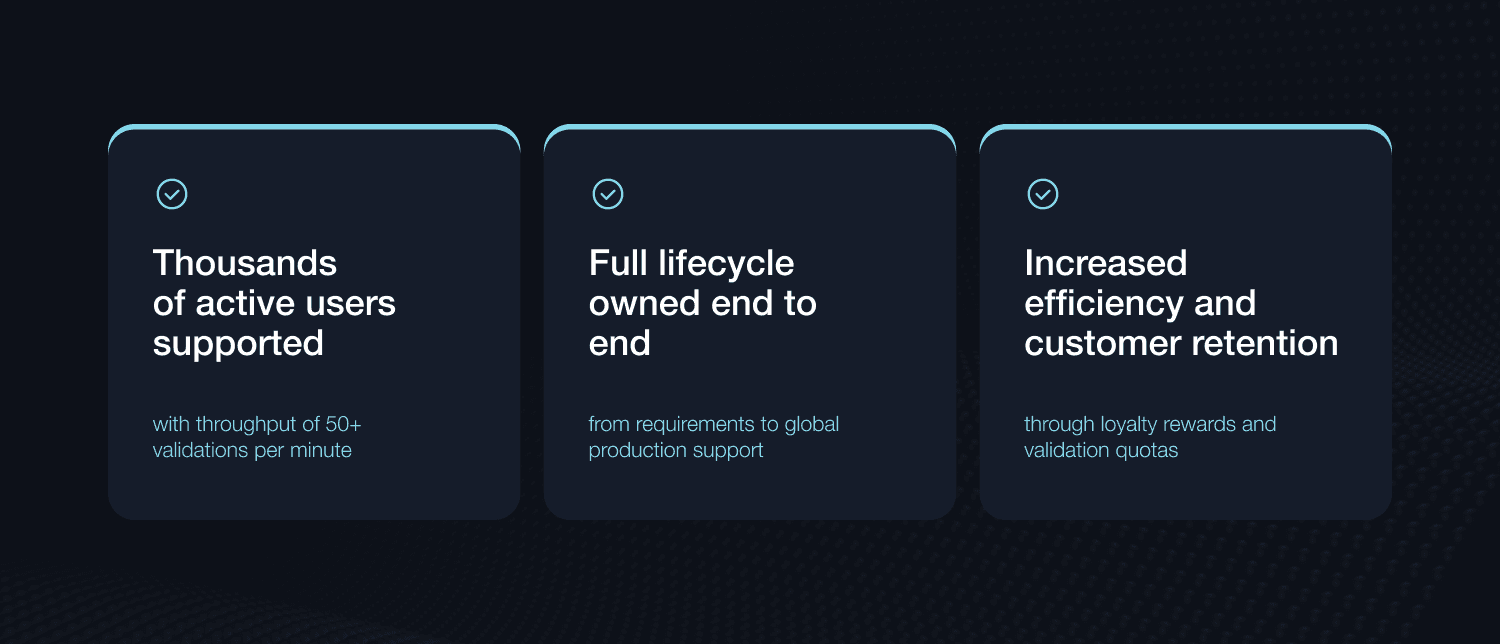
We owned the full lifecycle, from requirements gathering to global production support. We built the ecosystem as three synchronized surfaces from a single data point: a Flutter mobile app that lets visitors handle the entire validation flow themselves, a white-label Android kiosk that gives operators real-time control of validation and capacity, and an Angular/.NET web layer that ties it together. The core of the system is a fast validation engine that handles over 50 validations per minute, even during the busiest times. On top of it, an analytics and loyalty suite turned raw validation data into useful business tools, like capacity tracking, cash management, loyalty points, and validation quotas. An API-first integration layer let separate providers form cohesive regional networks.
This solution replaced a manual, hardware-dependent process with a secure digital ecosystem that has been adopted across facilities worldwide. The system efficiently manages peak loads and provides operators with real-time visibility into their entire operations.
Learn more about the contactless validation ecosystem →
4 Engineering Principles Behind Reliable Mobility Systems
Three different problems, yet the same engineering disciplines appear each time, and their absence is exactly what sinks systems that look fine in a demo and fail in production.
Governance as configuration, not code
In public-facing mobility systems, jurisdiction functions as a primary variable rather than an exceptional case. The free-flow enforcement platform was able to scale across the Nordics because its compliance logic was implemented as a configurable governance layer instead of relying on hard-coded rules. This approach is evident in other contexts where systems must adapt to diverse external requirements, such as the project involving the design of a plugin-based architecture to ensure compatibility with various third-party lift systems. Configuration enables systems to accommodate change more effectively than static code.
Idempotency and audit trails are revenue infrastructure
When traditional barriers are removed, software becomes the primary mechanism of enforcement. Each transaction must occur exactly once and remain defensible upon review. The idempotent design and structured audit logs in the free-flow platform were not just routine tasks. They made the difference between keeping revenue and losing it. In any system where financial and legal outcomes depend on data events, such measures are foundational requirements.
Abstraction over rip-and-replace
Organizations typically inherit existing infrastructure, which is seldom replaced. Both the traffic-intelligence bridge and the hardware-to-digital validation migration succeeded due to the implementation of a stable abstraction layer between legacy and modern systems. This approach helps each component to evolve independently without causing disruptions. Large-scale rewrites often lead to project failure, whereas constructing bridges between systems increases the likelihood of project success.
Interoperability designed in from day one
The EU’s EETS framework exists precisely to force interoperability across a fragmented tolling market, and to let member states exchange enforcement data across borders. The operators who thrive under that pressure are the ones whose platforms were API-first from the start, rather than the ones now facing a retrofit.
These four disciplines help manage complexity, not just engineer it. Competitive procurement incentivizes partners to adhere to fixed public timelines while maintaining quality standards. Compliance-by-design mitigates jurisdictional risk by preventing it from becoming a critical obstacle. Furthermore, ownership of the entire lifecycle, from requirements through long-term production support, enables continuous system evolution after launch rather than stagnation.
The Future of Tolling and Mobility
The transition within the industry is evident. The market is moving decisively from traditional toll plazas to multi-lane free-flow and all-electronic tolling, as well as toward road-user charging, congestion pricing, and distance- and emissions-based schemes. These mechanisms are not merely conveniences added to existing infrastructure; rather, they function as public revenue systems and instruments of public policy. In Europe, this transformation is effective only if systems stay interoperable across national borders. Otherwise, flexible charging introduces new barriers to traffic flow. As physical and regulatory barriers are reduced and pricing mechanisms become more sophisticated, the potential for revenue leakage, enforcement disputes, and compliance failures only grows.
All of those pressures ultimately land on the software. The challenge, then, is not simply to build for scale, but to build around the constraints that actually matter. As the product grows, those constraints will begin to define the product itself.
Talk to our engineering team about your next build →
See how Klika helps connected mobility organizations build and scale →