

Why Do Most Consumer Electronics Fail After Launch?
The curious case of consumer electronics: if a product ships, it means it passed lab tests. However, out there, in the open market, in the real world, most products simply fail.
QA chambers have their limits in simulation; on the other hand, kitchen counters, bathroom shelves, backpacks and bags loaded with keys and various other objects- these situations are the real field test, the test most companies fail to win.
Labs usually test temperature range, drop height, humidity ceiling, and vibration profile, while real tests are never that specific. Usually, real tests combine different elements into combinations nobody wrote into the spec sheet.
Every puddle you can drop your device in is unique. Drying it on a car dashboard in August or updating over a neighbor's borrowed Wi-Fi can get a different set of results. But we're not talking here about one dramatic event. It's never that. What happens in the field is the slow accumulation of edge cases a lab can't model, because nobody can afford to model all of them before launch.
SUPPLY CHAIN: THE ACHILLES OF CONSUMER ELECTRONICS
In 2026, we still see product timelines treating hardware and firmware as sequential, while in practice, they're the same decision made twice, at different speeds.
The rules are the same whether the product is a wearable, a smart appliance, or a connected fitness device. Some avoidable disaster scenarios are well known in consumer electronics: the firmware team hears about a component swap too late and ships code tuned for a part that's about to leave the bill of materials, or a hardware team locks the enclosure before firmware finalizes its OTA footprint.
Why avoidable? We can trace these mistakes to the same root problem: planning hardware and firmware as separate tracks. Catching the conflict before tooling is cut, instead of after, is the whole case for building them together.
In the last two years, we've seen disturbances in the supply chains, in cuts for several component categories, memory and certain microcontrollers among them. This creates a variable no team can control directly; they can only prepare their product for possible obstructions. AI datacenter demand has been pulling fab capacity away from what most consumer electronics run on.
Companies should steer away from locking their products to a single-sourced part; if the lead time doubles mid-build, the options are few. You can't forecast this happening, but you can change how we approach product design. By designing for substitution from day one, with qualified second sources and firmware that doesn't quietly assume one specific chip revision forever, we can keep the risk slightly lower.
OTA SAVES THE DAY
In August 2026, a personal vehicle manufacturer recalled around 200 units after finding they posed a crash hazard: they could maintain speed or accelerate when the driver released the pedal. The remedy wasn't a return or a repair shop visit: owners updated their vehicles through the company's mobile app to a firmware version the manufacturer had made available months earlier.
The mechanism matters here: a safety-critical defect closed with a software push instead of a truck roll. The same defect without OTA infrastructure costs a warranty claim, a recall, or worst of all, an injury or death.
Recall and safety-alert activity is climbing on both sides of the Atlantic, with the EU's Safety Gate system logging more than 4000 dangerous-product alerts in 2024, the highest since it launched in 2003. Cosmetics and toys made up the largest share, but electrical appliances and equipment accounted for about 10%. The US saw a similar pattern, and regulators are starting to define what "supported" means.
EU's Ecodesign Regulation requires smartphone and tablet manufacturers to keep providing OS and security updates for at least five years after a device is pulled from sale, with spare parts guaranteed for seven.
Compliance isn't automatic, and companies have argued that the rule requires updates to be free rather than guaranteed on a schedule; if a manufacturer didn't design for OTA, maintainability may not reach the five-year mark, even though the law requires it.
YEAR ONE CHECKPOINT FOR CONSUMER ELECTRONICS
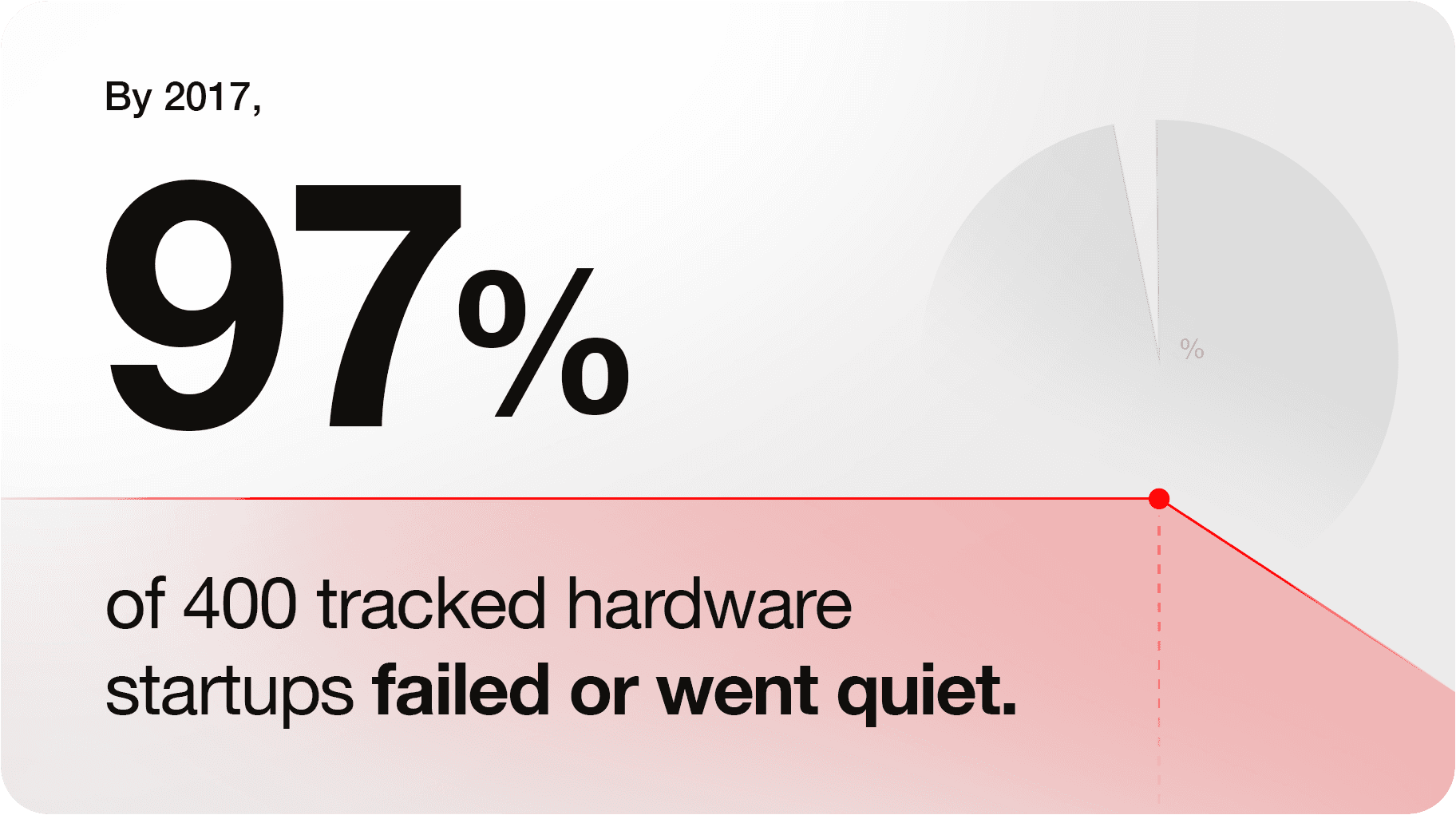
In 2017, one study found that of almost 400 hardware startups they had been tracking, 97% had died or gone quiet by 2017. These included wearables, juicers, game consoles, and other hardware categories that rode the same hype cycle, painting a clear picture: no one gets a guaranteed pass in the consumer electronics market.
We could argue that the numbers presented here are almost a decade old. Of course, the ecosystem has matured since, but we should pay attention to the underlying economics of the brutal category that is consumer electronics: real physical products cost real money to prototype, tool, and recall in a way a software bug doesn't.
There's always a case of arriving at the checkpoint many companies don't see: a year one on the market. There are no guarantees, but that happens much more often when the teams treat firmware, hardware, and supply chains as one planning problem. At Klika, we've seen this experience, and we established this planning pattern to build fleet-wide OTA firmware for a connected smart bed and restructure a client's hardware dependency to hit a tighter time-to-market.
Device working during the test phase in a lab? Great. You will get a customer.
But loyalty means making it work in someone's life for years after the team that built it has moved on to the next release.