
Beyond Chatbots: Building a Fully Autonomous Customer Support Workflow
If you've been part of the customer support team recently, you've most certainly celebrated your first chatbot deployment. And why wouldn't you? The wins almost seem like a video game combo: response times drop, simple queries get handled instantly, and the support inbox feels more manageable.
But within months, the excitement fades. Automation is stuck between 20% and 40%. Ticket volumes keep rising. Your agents start drowning. The bot handled the easy questions, sure, but everything else? Humans don't stay in the loop; they stay on the floor, buried under inquiries that won't stop coming.
This isn't AI failing. It's the plateau problem. The good news? There's a way to go through the roof.
The Chatbot Ceiling
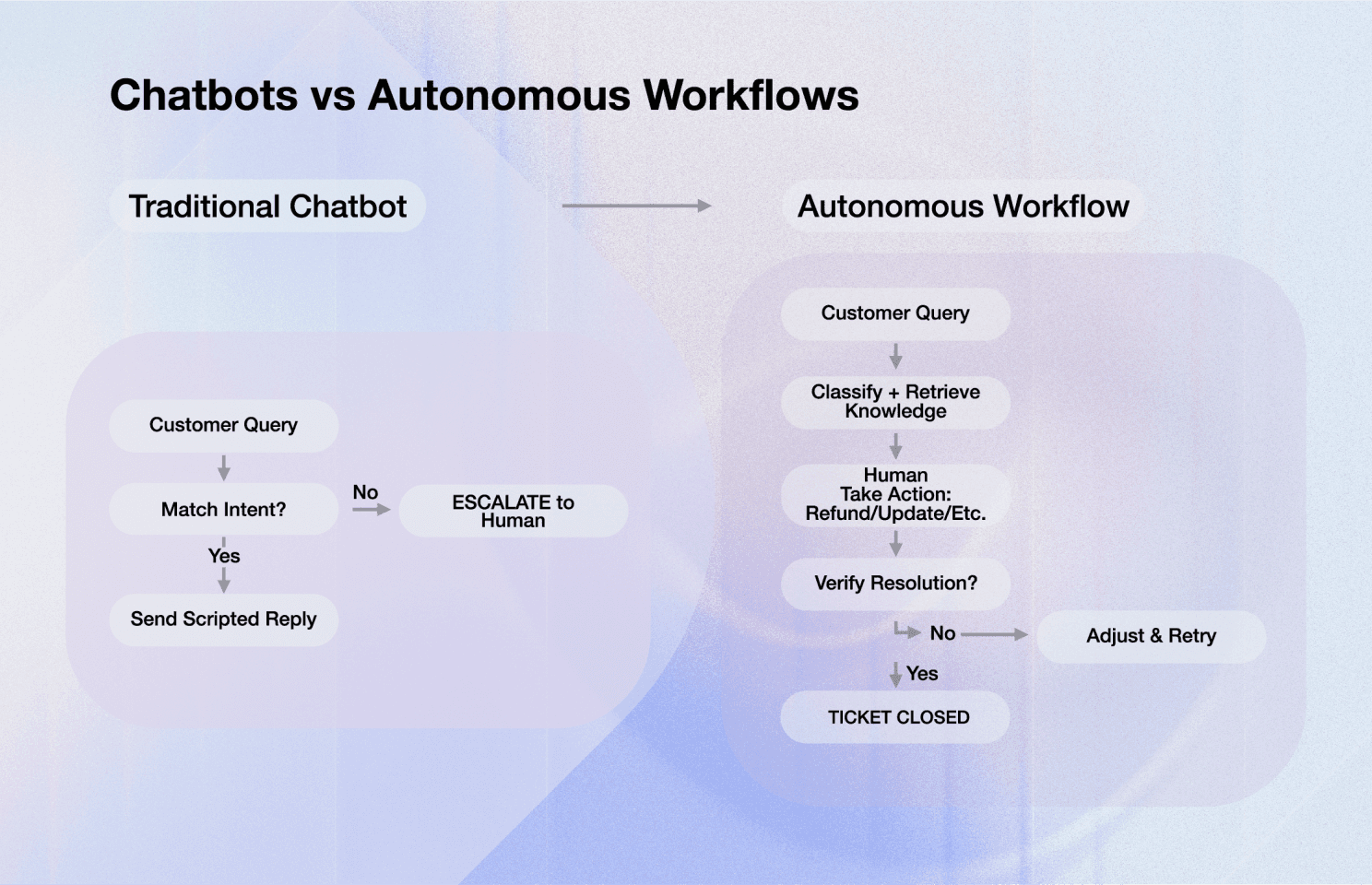
Traditional chatbots rely on scripted logic and predefined intents. They're amazing when it comes to answers to "What's your return policy?" or "Where's my order?" But throw a multi-step issue or an edge case at them, and they bail.
When numbers start flatlining, panic sets in, but the truth is, chatbots don't lack intelligence. They lack agency. They can recognize patterns and pull up information, but they can't actually own a problem. When things get complicated, they escalate and dump the work back on your team. You get some efficiency gains, but nothing transformational.
Autonomy goes beyond just generating responses. It's about owning the outcome. An autonomous agent gets a goal (e.g., resolve this ticket) and figures out how to do it using whatever policies and context it has access to. It evaluates the situation, selects actions, checks whether they worked, and adjusts as needed.
Instead of rigid scripts, it actually reasons through the problem. It talks to backend systems. It confirms the issue is resolved before calling it done. "I've processed your refund and updated your account," beats "Let me connect you with an agent" for everyone. The customer gets resolution, the company saves time.
How Autonomous Workflows Operate
An autonomous workflow isn't one bot doing everything. It's a system of multiple specialized agents coordinating with one another. Here are its essential components.
The Ticket Classification Agent sits at the entry point. It analyzes incoming requests to determine intent, urgency, sentiment, and priority. Takes messy, unstructured messages and turns them into clean data usable by the rest of the system. It's not matching keywords. It understands context.
The Knowledge Retrieval Agent hunts down whatever information is needed to solve the request. It searches internal docs, past tickets, product databases, and policy files. Uses semantic understanding, so it finds answers even when customers phrase things weirdly.
Then the system takes action. Updates records, triggers refunds, schedules callbacks, or escalates as appropriate.
Here's the difference, though: escalation isn't failure. It's a strategy.
Hello, Human. Let's Work Together
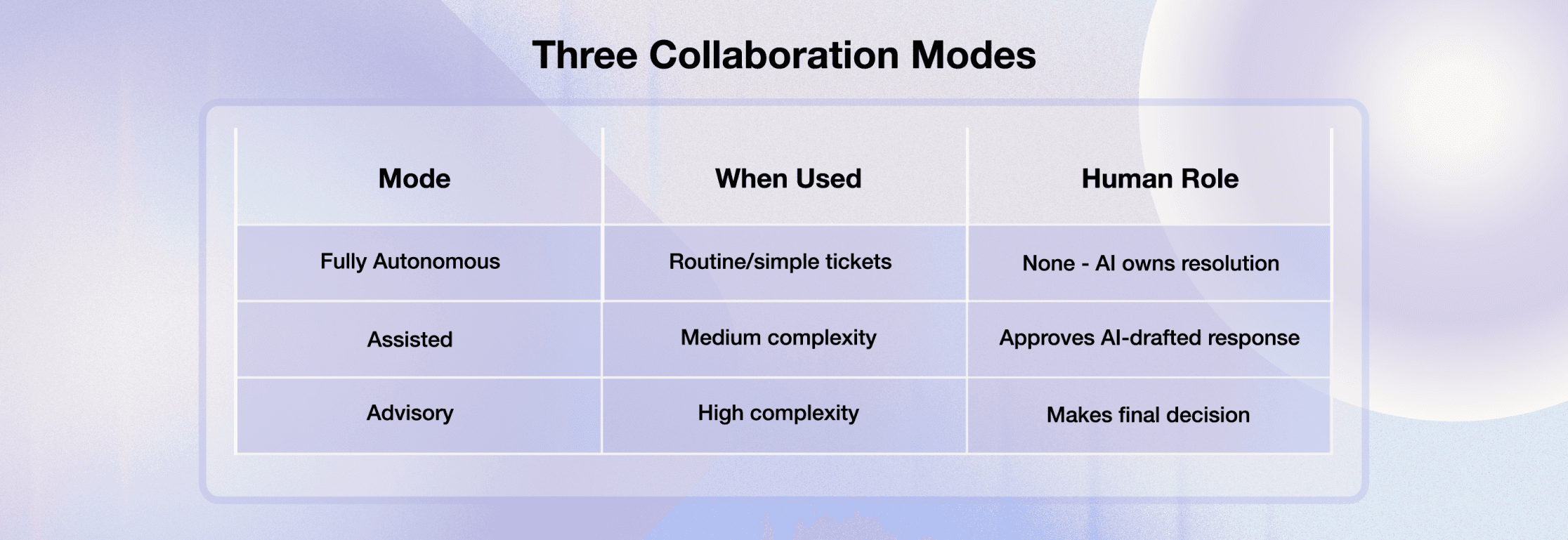
For those who fear this is the end of humans in customer support, it's not. Autonomous systems are built to work with human teams, not replace them. Depending on the stakes and the ticket's complexity, workflows operate in different modes.
Fully autonomous for straightforward stuff.
Assisted mode, where the agent drafts responses but a human approves.
Advisory mode, which gives recommendations.
High-stakes situations? Those are routed to humans. Routine requests handle themselves. This is about giving people time to focus on cases where empathy and nuanced thinking actually matter, and that is what humans (still) do the best.
Keep in mind that no system is perfect. Customers are unpredictable; edge cases happen, and sometimes the right answer requires reading between the lines and understanding context that no policy document covers.
The rule of thumb remains: Autonomous agents handle patterns incredibly well. Humans handle exceptions better.
Measuring What Matters
Shifting from chatbots to autonomous agents means your metrics need to shift, too. Auto-resolution rate is important, but so is first response time, average resolution time, escalation rate, SLA compliance, customer satisfaction, and cost per ticket. You're not just trying to deflect tickets anymore. Quantity, yes, but you also want quality resolution.
Early adopters are seeing real improvements, and the research backs it up: Gartner research says autonomous AI will resolve 80% of common customer service issues by 2029.
Why This Matters Now
Customer expectations keep rising, and some companies call that spoiled. It's not. Expectations evolve with technology. Support volumes grow, teams stretch thin, and the message is clear: be quick or be forgotten.
To use video gaming terminology, chatbots are level 1 allies. They will buy you some breathing room, but they won't fix the core issue: most support work is repetitive, totally solvable, and shouldn't need a human.
If your automation is stuck, don't settle for a "better chatbot". You need a system built for autonomy. One that actually resolves issues instead of just responding to them. One that closes the loop instead of deflecting and hoping.
The technology is here. Moving from scripts to results means rethinking what you're even trying to accomplish with automation.