
Productization: Why Clients Are Buying Outcomes, Not Effort
In the last 2025 edition of Techtonic, we sat down with Klika's Ognjen Koprivica (Director, Engineering) to discuss the evolution of software delivery in 2026. The industry is shifting toward productization, reflecting client demand for outcome-driven tech packages with fixed results and predictable costs.
From cloud migration packages with zero-downtime guarantees to agentic workflows, this conversation explores how productized services de-risk delivery while freeing teams to focus on genuine competitive advantage. Thank you for being part of the Techtonic audience, and we'll see you in 2026!
Let’s start with the big picture. What kinds of solutions will shape the business horizon in 2026?
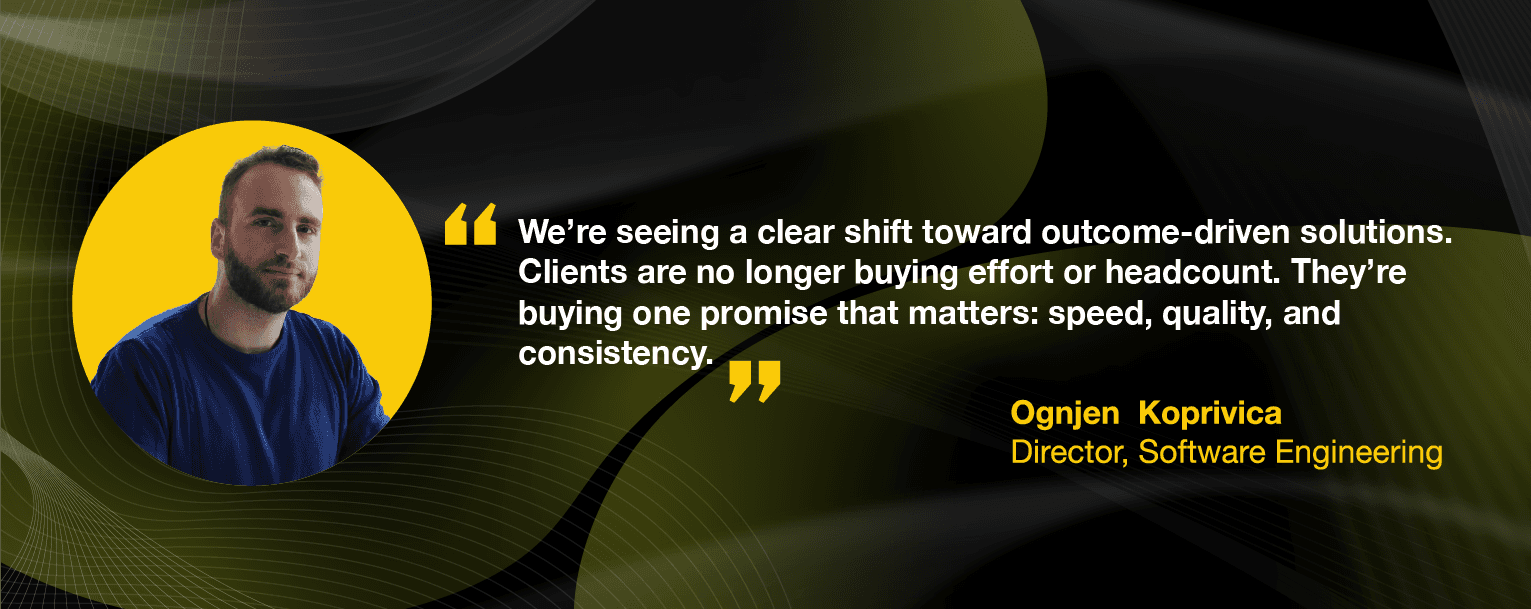
We’re seeing a clear shift toward outcome-driven solutions. Clients are no longer buying effort or headcount. They’re buying one promise that matters: speed, quality, and consistency. As markets move faster and systems become more complex, variability is what hurts most. Organizations want to know not just what will be built, but how reliably it will be delivered. That’s what’s driving the move toward productized, repeatable delivery models.
You often talk about “tech packages.” Can you paint a picture of what that actually looks like?
Traditional services usually sell effort: „We’ll build X with Y people.“ The problem is that outcomes vary because delivery depends on the team, the process, and the amount of rework that shows up midstream. A tech package sells a repeatable outcome. For example, Cloud Migration Package; instead of billing for 500 hours of engineering, the vendor promises: "We will migrate your 20 servers to AWS in 4 weeks with zero downtime for a fixed price."
The package includes the pre-tested Terraform scripts, automated security scanners, and rollback mechanisms. If it takes longer, the vendor eats the cost. If it’s faster, they win. The client isn't buying hours; they’re buying a validated system.
On paper, that sounds great for the client. What about a clearly massive shift for the vendor? Service firms are built on the billable hour. How do you think that transition will be managed?
Transition is painful, but necessary. It starts with changing the sales incentives. You stop training sales teams to sell "blocks of time" and start teaching them to sell "risk mitigation." The financial trade-off is short-term pain for long-term stickiness. When you sell hours, the client leaves when the budget runs out. When you sell outcomes, the client stays because you’ve embedded a system that works. The vendor wins by reusing what works and shipping with fewer defects, not by billing more hours. That’s how you get stronger SLAs and a lower long-term maintenance burden.
You mentioned IP as a differentiator. How does that actually de-risk delivery compared to a classic Statement of Work?
Statements of work sell people. Tech packages sell outcomes backed by IP, accelerators like data models, DevOps pipelines, security guardrails, and compliance-ready patterns. That de-risks delivery in three ways: Speed: Teams start from proven building blocks, not a blank page. Quality: Defaults are battle-tested and aligned with common control expectations, such as ISO-27001. Consistency: Every engagement runs on the same “package version,” avoiding snowflake environments.
AI is often framed as a productivity booster. Where does it actually remove delivery friction?
The real leverage isn’t AI as a code generator. It’s AI embedded across the entire software delivery lifecycle. Most delays don’t come from writing code. They come from ambiguity, rework, slow reviews, flaky tests, and brittle releases. AI helps where those problems actually live: discovery, implementation, review, and operations. At the core, most delivery delays are information problems: tacit knowledge, manual validation, and late-stage rework. When AI sits at each stage, feedback loops tighten, and issues get caught while changes are still cheap.
While on the topic of AI... no matter its strength, general-purpose AI doesn't seem like „enough“ for enterprise use cases. Can you explain why?
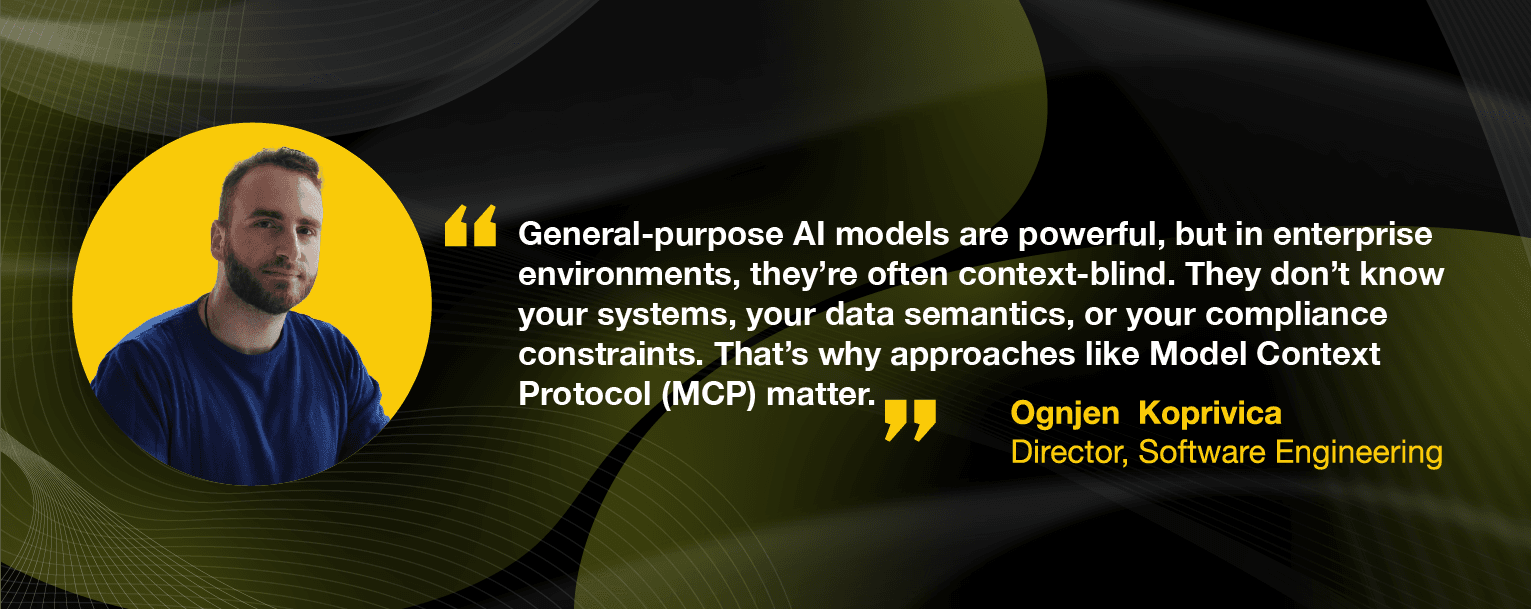
General-purpose AI models are powerful, but in enterprise environments, they’re often context-blind. They don’t know your systems, your data semantics, or your compliance constraints. That’s why approaches like Model Context Protocol (MCP) matter. MCP gives AI structured, governed access to enterprise truth via approved connectors. A simple way to think about it: general-purpose AI gives you vocabulary. Enterprise-connected AI gives you fluency in your business language — safely.
Is enterprise AI today over-focused on data access and under-focused on decision-making? Where do agent skills change that equation?”
MCP is about grounding—giving the AI eyes into your data. Agent skills are about execution, giving the AI hands and instincts. Think of it like a road trip. MCP is the GPS: it provides the map data, traffic conditions, and route options (the enterprise truth). Agent skills are the experienced driver: the agent knows how to merge safely, when to change lanes, and how to handle a skid (the reasoning steps and decision heuristics). In mature setups, the strongest architectures combine both: MCP for grounding and verification, skills for execution and decision-making.
Critics might say that „productized“ services and AI agents lead to „cookie-cutter“ solutions that lack innovation. How do you balance efficiency with the need for bespoke work?
That is a valid concern, but the view is slightly backward. Tech packages handle the 80% of work that is undifferentiated „heavy lifting“: the boilerplate, the plumbing, the compliance checks. By commoditizing that, you actually free up your smartest humans to focus on the 20% that drives genuine competitive advantage.
We don’t use packages to kill innovation; we use them to clear the deck so innovation can happen faster. You don't break the package to be different; you extend it.
Agentic workflows seem to be everywhere right now. Why are they becoming non-negotiable?
In sectors such as healthcare, finance, and customer service, demand already outpaces human capacity, making consistency critical. A well-designed agentic workflow follows a loop: goal → plan → tool use → verify → escalate. The key isn’t „agents everywhere,“ but agents with guardrails, governance, and a clear operating model. They need to be able to say, „I’m not sure. Let me verify or escalate.“ That uncertainty-aware capability is essential in high-stakes domains.
For many companies, their AI efforts are fragmented or stuck in pilots. What can be done about that?
That’s where an AI integration roadmap becomes essential. Without one, AI remains experimental and fragile. A strong roadmap must connect technical architecture to business value, covering the current state, use-case portfolio, target architecture, and governance. Specifically, you need to define your „human-in-the-loop“ rules early. If you don't decide when a human must approve an action, the AI will either stall or hallucinate.
Finally, with all this automation and AI, what does the day-to-day work of a human engineer look like in 2026?
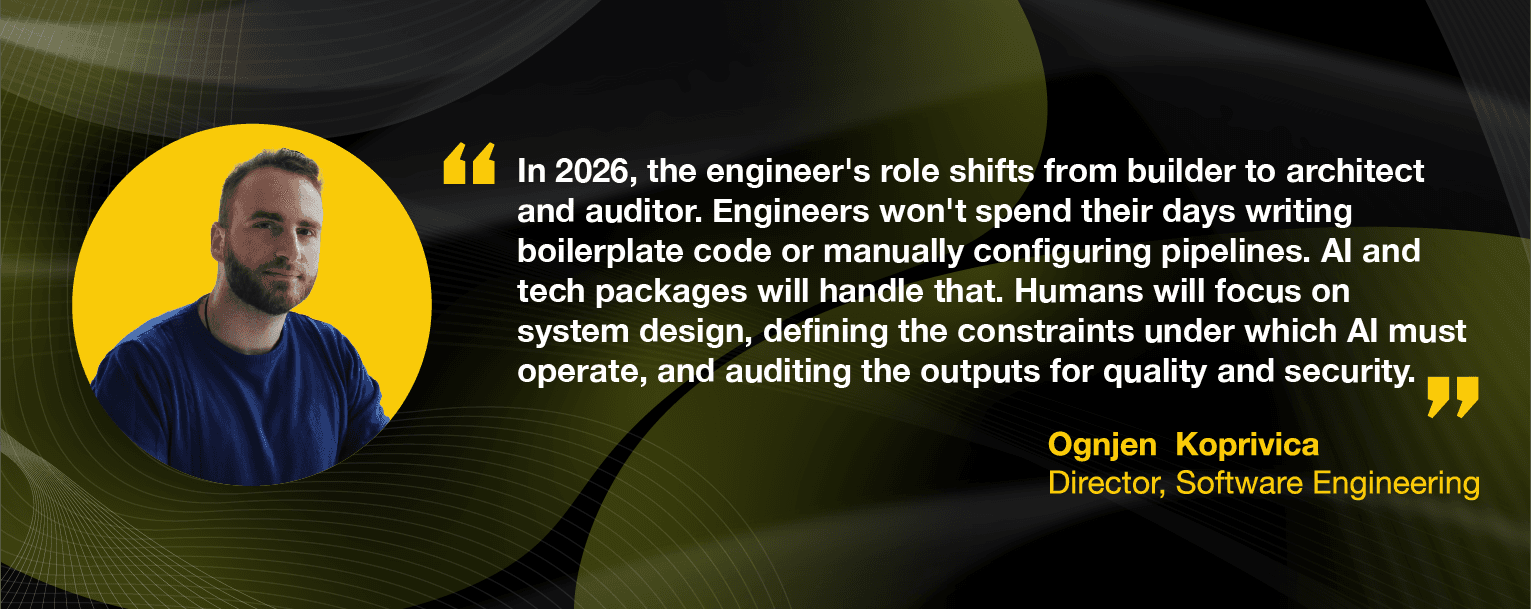
The role shifts from builder to architect and auditor.
Engineers won't spend their days writing boilerplate code or manually configuring pipelines. AI and tech packages will handle that. Humans will focus on system design, defining the constraints under which AI must operate, and auditing the outputs for quality and security. The most successful organizations aren’t just doing the same work faster; they’re redesigning jobs around AI. That’s where durable competitive advantage is built.