
Late Adopters: Why To Say Yes (or No) To AI
AI seems to be everywhere these days, but despite its apparent dominance, some businesses remain hesitant to adopt new technologies. Previously, we discussed choosing the right LLM model for your business. In the March 2025 edition of the Techtonic newsletter, we spoke with Haris Pandžić, Klika's Engineering Manager, to explore the mindset of late adopters, recommended AI tools for skeptics, and, most importantly – whether AI will take over our jobs.
Surprisingly, there are many late adopters regarding AI integration. In your own experience, what are the reasons why some people and businesses are hesitant to adopt AI?
Many people and businesses are still hesitant to adopt AI, and from my experience, they tend to fall into two groups.
First, a small group of people were early adopters of AI but ended up disappointed. They tried tools like ChatGPT when they first launched, expecting something groundbreaking, but gave up when AI didn't live up to their expectations.
Then, a much larger group either doesn't fully trust AI yet or feels it still doesn't meet their needs. Some are concerned about data privacy, reliability, or losing control over decision-making, while others find AI too complex or not yet essential for their work.
Interestingly, both groups share a common trait-they expect AI to be more advanced than it actually is. While AI has made significant progress, it's still not at a point where it can replace most jobs or integrate seamlessly into every business without challenges.
Is there any industry more susceptible to the denial of AI integration?
Absolutely. Given AI's current limitations, such as hallucinations, lack of context, and its tendency to generate answers even when unsure, it's clear why it's not yet production-ready for many industries.
Some fields require pinpoint accuracy, where a single mistake can cost millions or put lives at risk. These industries don't have the luxury of simply telling a chatbot, "You're wrong," and moving on. A doctor can't risk an AI casually suggesting, "Try removing the other kidney instead," just as a financial analyst can't afford an AI confidently making trades based on a nonexistent trend. In these cases, even a tiny mistake isn't just an inconvenience-it's a severe liability.
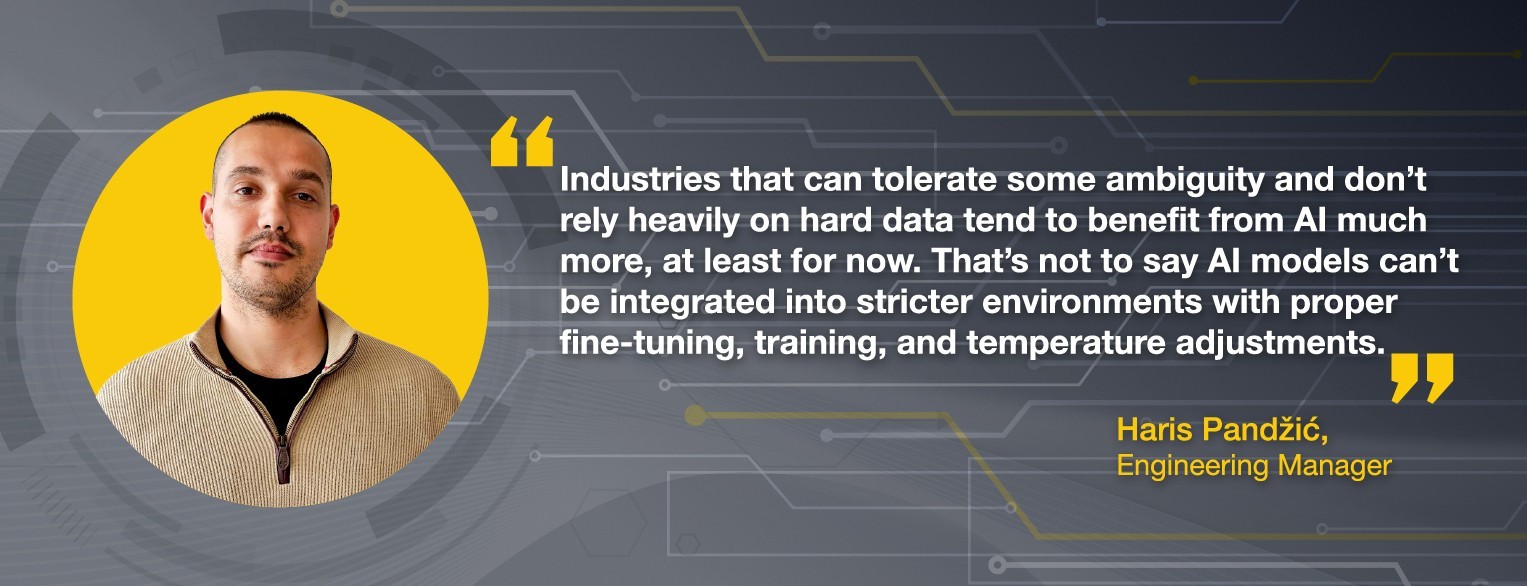
On the other hand, industries that can tolerate some ambiguity and don't rely heavily on hard data tend to benefit from AI much more, at least for now. That's not to say AI models can't be integrated into stricter environments with proper fine-tuning, training, and temperature adjustments.
However, these cases require much more caution and human supervision.
Can you share some simple AI tools that late adopters can start using today?
For late adopters, I recommend starting with just one AI tool rather than exploring every new shiny option. The best choice is ChatGPT, simply because it's the most widely available and well-supported tool. There's no need to complicate things when getting started.
I suggest integrating ChatGPT into your daily routine for personal use to assist with decision-making and problem-solving. However, it's important to use it wisely. AI isn't meant to replace your thinking-it's there to speed up your process and help guide you toward better answers.
Again, for business or product integration, it's best to start small. Logically speaking, ChatGPT is a great first step, even if it costs more than other tools, simply because of its large community and proven set of functionality. This is particularly helpful for automating repetitive or low-value tasks that don't require much critical thinking. The goal is to free up time for more meaningful work by eliminating easy obstacles. Once that foundation is in place, businesses and individuals can explore larger AI-driven projects with more confidence.
Are there any AI integration challenges that rise from being a late adopter?
It depends on what you consider a challenge. As a late adopter, you benefit from learning what works and what doesn't because others have already tested and failed. This can save money on bad proof-of-concepts and unrealistic ideas.
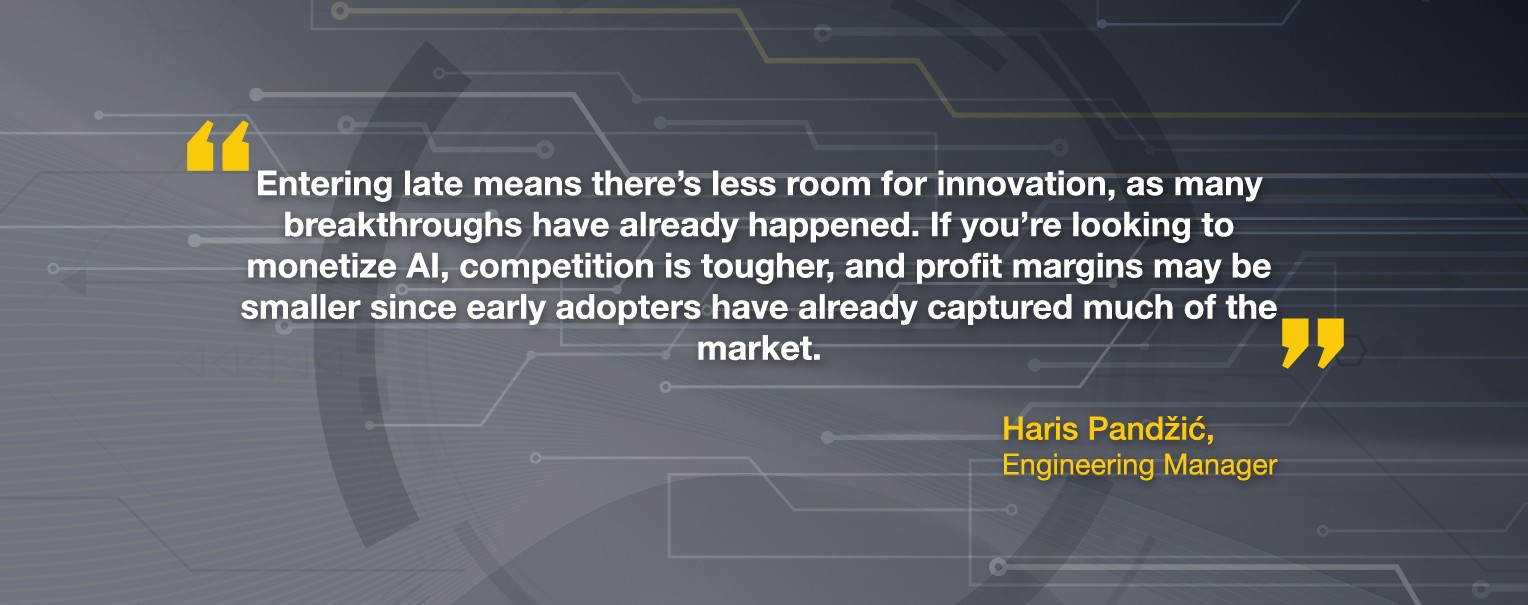
However, entering late means there's less room for innovation, as many breakthroughs have already happened. If you're looking to monetize AI, competition is tougher, and profit margins may be smaller since early adopters have already captured much of the market.
That said, late adopters can still succeed by focusing on refining existing solutions, making them more user-friendly, cost-effective, or industry-specific rather than trying to reinvent the wheel.
Many times we hear AI will take away jobs. The fear is real, but is it grounded in reality?
This is a tough topic to tackle. The fear is grounded in reality, but only to a certain extent. It depends on the industry and the type of work being done.
In IT, for example, AI is shifting the focus away from purely technical skills and toward a broader understanding of business cases, product development, and overall strategy. This pushes more people into roles requiring technical knowledge and decision-making skills, such as Technical Product Owners or Engineering Managers. Rather than replacing skilled professionals, AI is changing how they work and what skills are most valuable.
Repetitive, standardized jobs are at a higher risk, not just in IT but in many industries. However, this isn't a new concern. Since the Industrial Revolution, automation has steadily replaced manual tasks, allowing people to focus on more complex and creative work. AI is just the next step in that process, and while some jobs will be lost, new opportunities will also emerge for those who can adapt.