

Model Context Protocol (MCP): A Silver Bullet?
You may have heard about the brand-new, shiny toy of the tech industry: Anthropic’s Model Context Protocol, abbreviated as MCP. Introduced by the creators of Claude AI in 2024, this framework is an open-standard, open-source communication layer.
It allows AI systems to interact with tools, services, and data sources. MCP is a “universal key” or “API for AI”, if you will, that enables AI to access databases, APIs, file systems, and third-party applications without requiring custom code for each connection.
Its primary benefit is providing AI systems with a standardized way to connect to your databases, applications, and tools.
"But (and there is always “but”), every new technology comes with caveats; in this issue of Klika’s Techtonic, we’ll discuss the pros and cons of MCP integration.
MCP in Industries – Do You Need It?
First, let’s state the most obvious.
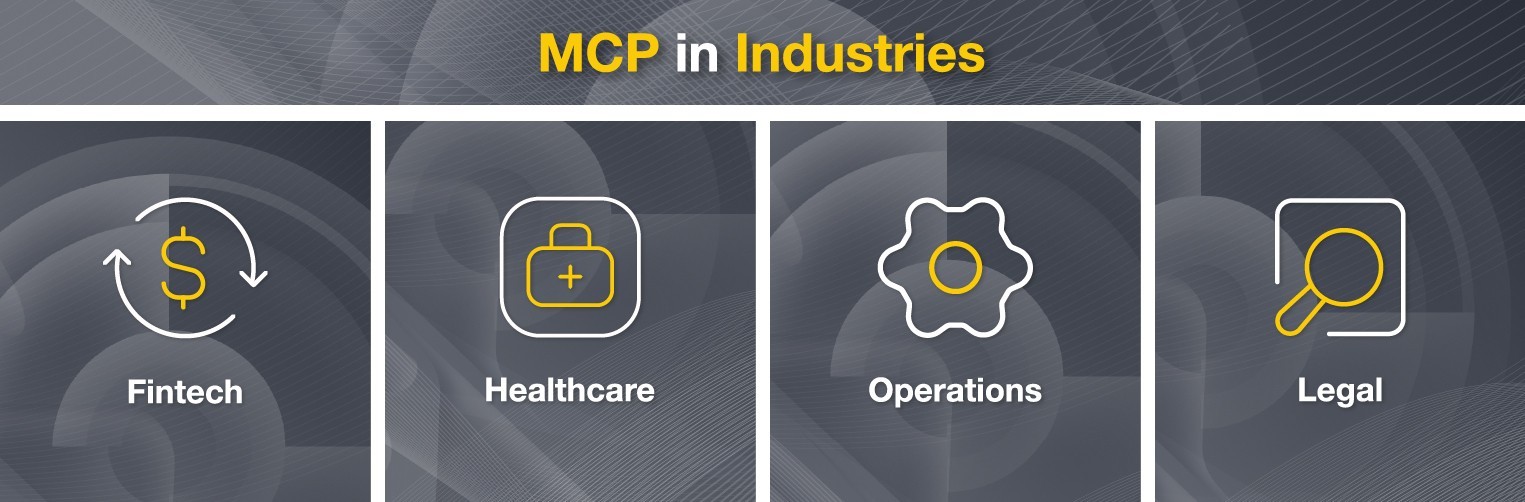
MCP is making its way in various industries, as it provides a standardized approach for AI systems to access and share data across different tools and platforms. Here are some common examples in financial services. MCP connects AI with regulatory databases, trading platforms, and risk management tools. It can maintain strict security protocols.
Healthcare organizations can utilize MCP to integrate AI with digital health records, diagnostic systems, and research databases, thereby enhancing patient care and outcomes. MCP ensures compliance with both privacy regulations and protocols.
Manufacturing companies utilize MCP to integrate AI systems with supply chain databases and quality management systems. E-commerce businesses use MCP to connect AI with inventory systems, customer databases, and logistics platforms.
Legal services can improve efficiency in research and review by utilizing MCP to connect AI research tools with case management systems, documentation repositories, and public regulatory databases.
It is wise to remember that MCP is not the only way to interact with data sources, and that some other methods may be more suitable for different use cases. If your particular case calls for a standardized way data is shared in the agent communication workflow, MCP may be a solution.
How To Implement Model Context Protocol (MPC)
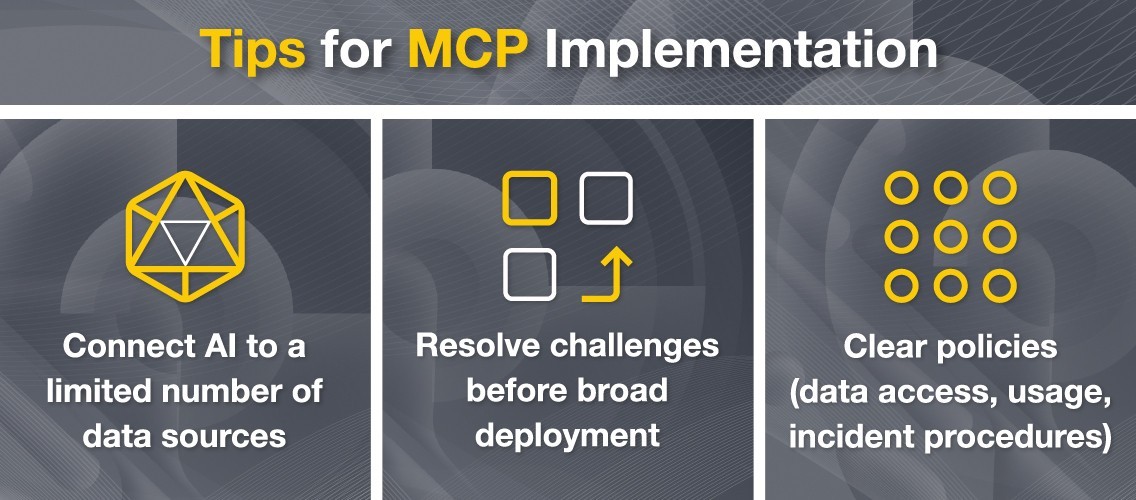
If you’ve spent some time thinking about reasons why MPC adoption might be a good thing for your business, here’s advice you don’t want to skip: establish protocols and start small.
Businesses should implement pilot projects that connect AI systems to a limited number of data sources through the MCP. This helps improve understanding of capabilities and limitations, as well as identifying potential challenges that need to be resolved before wider deployment. It is essential that clear policies for data access, usage monitoring, and incident response procedures follow MCP integration.
This is important because security architecture becomes more complex when AI systems access multiple data sources. Businesses require authentication, authorization, and audit systems to effectively monitor AI interactions.
If you’re part of the business integrating MCP by yourself, don’t forget to educate your staff on new technologies. This training extends beyond standardized AI usage to include MCP management, security monitoring, and potential troubleshooting.
Model Context Protocol (MCP) Risk Assessment
There are several MCP risks and ethical considerations that must be considered before integration. These risks are fully minimized through the integration by experienced personnel.
Data security becomes a primary concern when AI systems access multiple sources through the MCP. A compromised AI system could potentially reach all connected resources and system dependencies. If MCP connections fail, AI systems may deliver incomplete results that could disrupt business operations.
A question of compliance becomes more complex when AI systems access data through MCP. Companies must ensure that their AI usage complies with all relevant regulations for each connected data source. Be cautious of the risk of vendor lock-in, which can occur when businesses become overly dependent on specific MCP implementations.
As for ethical considerations, the big one is data transparency. Employees need to have a set of policies on why a data set is being accessed. On the other hand, clients need to understand how their data is being used.
Potential cases of bias amplification may occur when AI systems access biased data sets through MCP connections, potentially perpetuating existing biases across organizational systems.
(Don't) Believe The Hype
The hype around Model Context Protocol (MCP) is real. It has gained attention as a concept for building more advanced AI integrations, offering a structured way for models to maintain persistent context, interact with tools, and coordinate workflows.
Logically, overhype leads to misapplication, usually by teams who want to appear „AI-ready“ without defined use cases. Witnessing the MCP boom, those in the industry may hauntingly be reminded of the microservices boom a few years ago. Microservices were hailed as the antidote to monolithic codebases. Big words were thrown around - we were promised flexibility, scalability, and autonomy.
Many organizations have adopted microservices prematurely, often without an apparent necessity. This resulted in over-complicated systems and fractured deployments.
The industry eventually recognized that microservices are powerful, but only when their integration is justified by scale, domain complexity, and team size. This is the same approach we should take with the Model Context Protocol.
Model Context Protocol (MCP) is often touted as a silver bullet lately. Let's be honest: it is not. Unquestioningly believing this may lead to problems more complex than the ones we're trying to fix or avoid. The key with architectural decisions is to match the solution's complexity to the problem's complexity. Following industry trend curves is not a recommended approach.
Teams should treat MCP not as a default framework, but as an advanced pattern, best reserved for situations where its capabilities are truly essential.