
Showing Progress Without Burning Cash: A Founder's Guide
As a startup CEO, you’re walking a tightrope. The abyss seems bottomless and most of the time pretty scary, no matter your previous experience. Investors demand visible progress, the team is stretched thin, and every Dollar, Euro, Yen, and Pound spent feels like it could make or break your dream.
The pressure to show momentum while maintaining quality and managing burn rate creates an impossible equation. Or is it that you’re doing it the wrong way?
The truth is, most founders approach progress the wrong way. They think bigger teams and faster execution automatically translate to investor confidence. That truth leads to another - strategic progress beats frantic scaling every time.
The Metrics That Matter to Investors
Before you hire your next developer or launch another feature, stop and ask: What does progress look like to your investors? It’s not about how many people you have on payroll. It’s about the milestones that prove your startup is moving toward product-market fit.
Focus on the Big Three that investors care about:
MVP completion with core functionality that solves your identified problem
Measurable user activity that shows people want what you’re building
Early traction indicators like user growth, retention, or revenue. Even if the numbers are small!
These metrics all have something in common; they tell a story of validation, not just activity. A team of Big Three that shows consistent user growth will impress investors more than a team of ten struggling to find their product direction.

Scaling Too Fast? There’s a Better (and Safer) Way
Here’s where most founders make a (costly) mistake: they think demonstrating progress requires building a large in-house team quickly.
Scaling prematurely is one of the fastest ways to crash and burn through your funding without meaningful results.
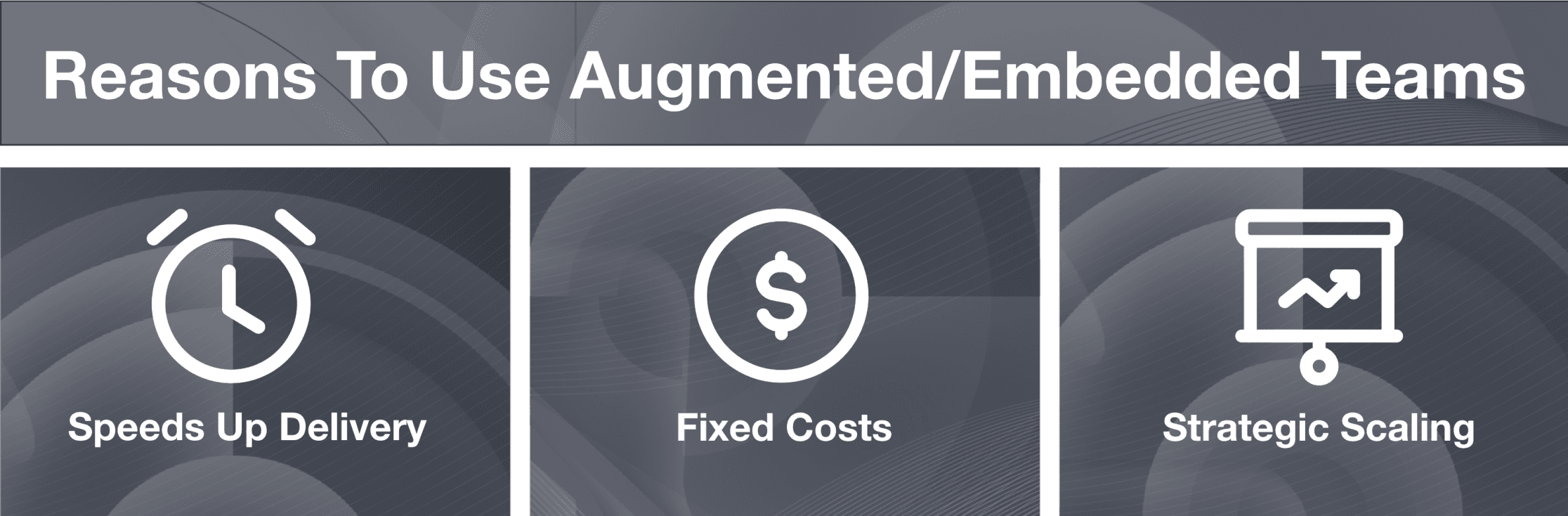
A great strategy to consider is using embedded or augmented team models. Partner with specialized development teams or individual experts who can integrate seamlessly with your core team without the overhead of full-time hires.
This approach has several advantages. It:
Speeds up delivery when you need specific expertise or extra bandwidth
Keep fixed costs manageable without permanent headcount increases
Scale strategically rather than reactively
Treat these partnerships strategically, not as emergency solutions. Identify where your team needs augmentation. It could be frontend development, mobile expertise, or specific technical skills. Then bring in targeted help for defined projects or the particular milestones.
The Milestone Approach
If you’ve heard of S.M.A.R.T. goals, a similar method can be used to break down your roadmap. When creating it, divide it into measurable, time-specific milestones that meet investor expectations. Avoid vague goals like “platform improvements,” and choose specific tasks such as:
“Complete user authentication system with social login options by month-end”
“Achieve 25% improvement in user onboarding completion rate”
“Launch referral program and track first 100 successful referrals”
This approach serves multiple purposes:
Keeps your team focused on high-impact tasks
Provides clear progress markers for investor updates
Helps identify when you need additional resources versus refocused priorities
Consistency builds credibility, and investors appreciate predictability. Even if progress is slower than hoped, regular milestone completion demonstrates that you can execute on your plans.
Progress Should Be Tangible
Investors need to understand your progress quickly. Raw metrics and lengthy updates are not that charming and often get lost in their inboxes. Remember that, more often than not, perception IS reality. Half of the job is how you sell it. Therefore, make your wins visual and immediate:
Create simple dashboards that highlight key metrics with clear trend indicators
Use screenshots of new features or user feedback highlights
Share quick video demos to make abstract progress feel real
Send weekly or bi-weekly updates rather than monthly deep-dives
Short, consistent communication with clear wins and honest challenges builds investor confidence more than sporadic comprehensive reports.
High! Impact! Deliverables!
A feature that took weeks to build but barely moves user activity isn’t impressive. It’s a waste.
Before committing to any task, ask whether it directly contributes to proving your core hypothesis about user need and market opportunity.
Focus on tasks that compound. User analytics implementation might be less exciting than a new feature, but it enables better decision-making for months to come. A referral system might be simple to build, but could drive organic growth that impresses investors far more than a complex feature nobody uses.
Don’t believe us? Search for the story of Dropbox’s referral system.
Progress Is Not a Straight Line
Showing real progress isn’t about burning through cash or overworking your team. Investors want to see that you can execute efficiently and make data-driven decisions that move your startup closer to success.
Remember that your focus needs to be on investor-relevant metrics, using augmented teams strategically, and breaking work into measurable milestones. That way, you can build momentum without breaking your budget.
The goal isn’t to impress with how much you’re spending-it’s to prove you can build something people want with the resources you have.