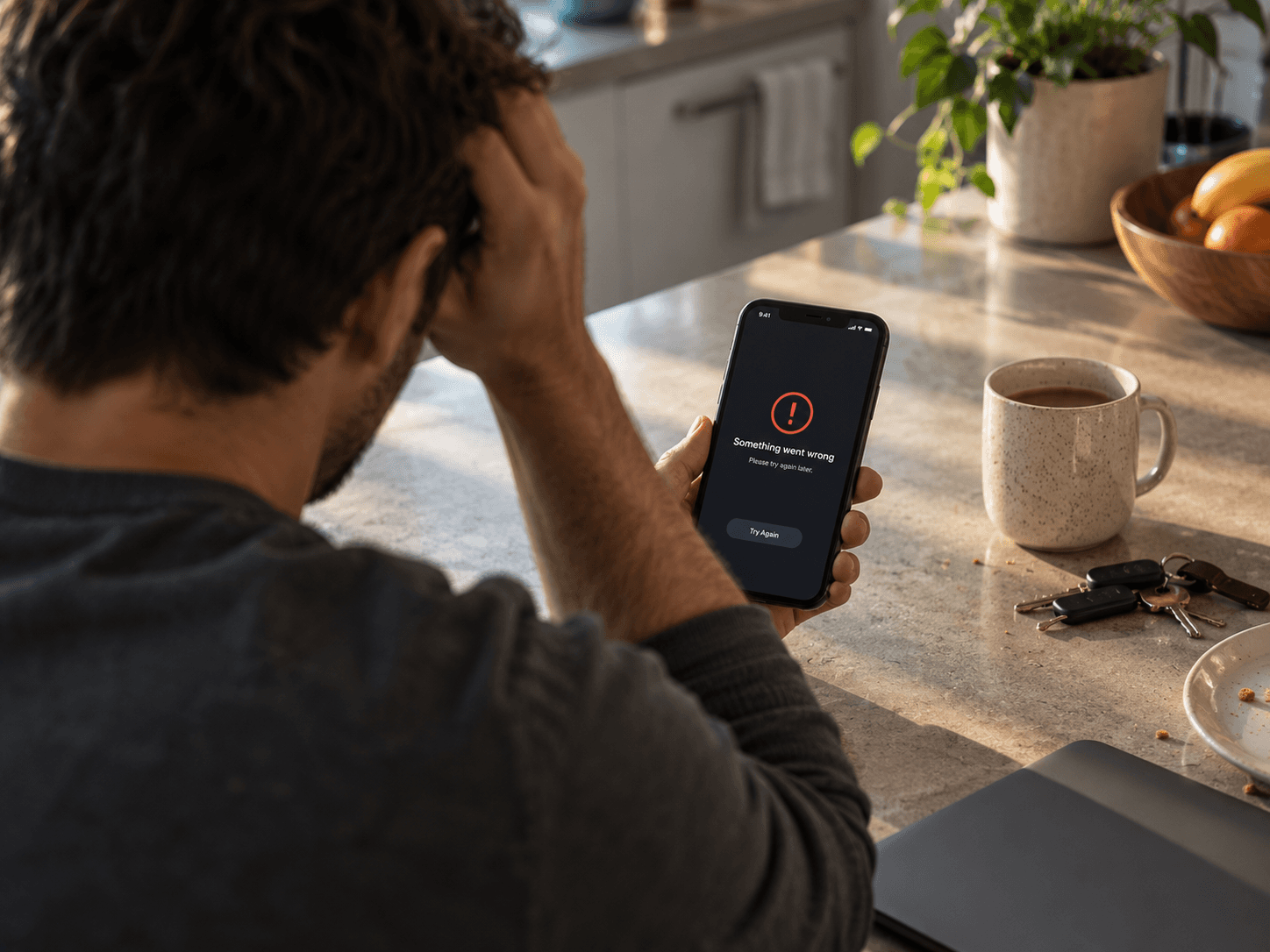

When the Ward Goes Home, the Engineering Has to Follow
Healthcare and life sciences organizations are operating in one of the most demanding industry environments. Regulatory pressure, data sensitivity, workforce strain, and rising patient expectations compound each other.
In a traditional inpatient setting, medication management redundancy has been baked in over decades: pharmacists, barcoding, nursing verification, and EMR alerts. The future demands that products be able to replicate or replace parts of that chain in an environment not fully under the product owner's control.
Modern healthcare is delivered at the push of a button/screen. That's genuinely powerful, but a button/screen misconfigured, mistimed, or untested in a real home environment doesn't just underperform... In a medication workflow, it can cause serious harm.
The failure modes tend to cluster around a few predictable areas:
Integration gaps between monitoring tools and the EMR: Data that lives outside the record doesn't change clinical decisions, it just creates a shadow workflow that staff have to reconcile manually. For already stretched nursing teams, that's not a minor inconvenience.
Alert logic designed for the wrong context: Thresholds tuned for an inpatient ICU generate noise in a home setting, and alert fatigue in a virtual care team has real consequences for patients.
Dispensing and adherence-tracking systems that assume too much: Smart dispensers and reminders work well in controlled pilots. Scaling them to a diverse patient population with different literacy levels, device familiarity, and home setups is a different engineering and UX challenge entirely, one that directly affects whether patients actually trust and use your product.
Compliance architecture bolted on late. Medication data in a home-care context touches HIPAA, GDPR, MDR, and broader AI governance requirements. Products that don't build for this from the start spend significant time and credibility retrofitting it.
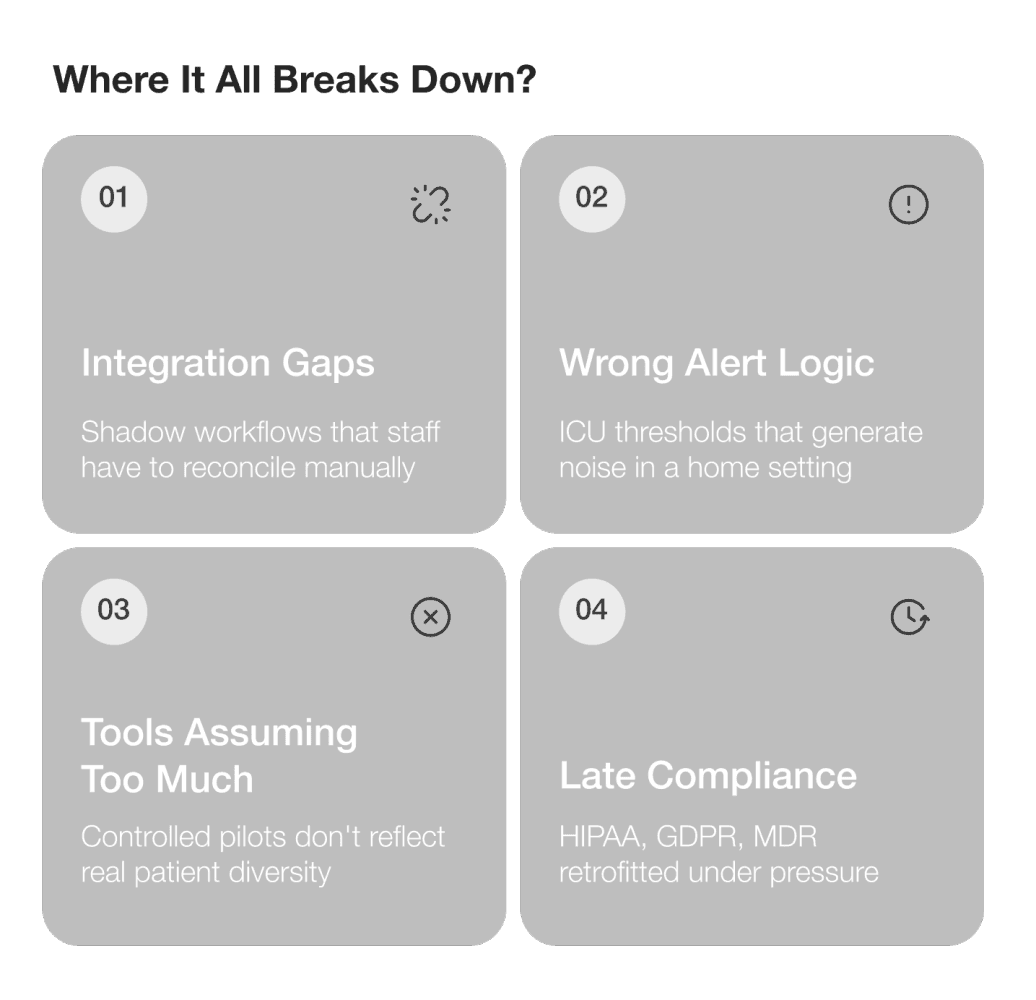
What is common to all these challenges? None of these is unsolvable, and all of them are more expensive to fix after launch than before.
Where the Real Engineering Work Happens
Teams that navigate this well treat workflow design and technical architecture as a single conversation rather than as sequential phases. They map clinical workflows before writing requirements. They design interoperability from day one.
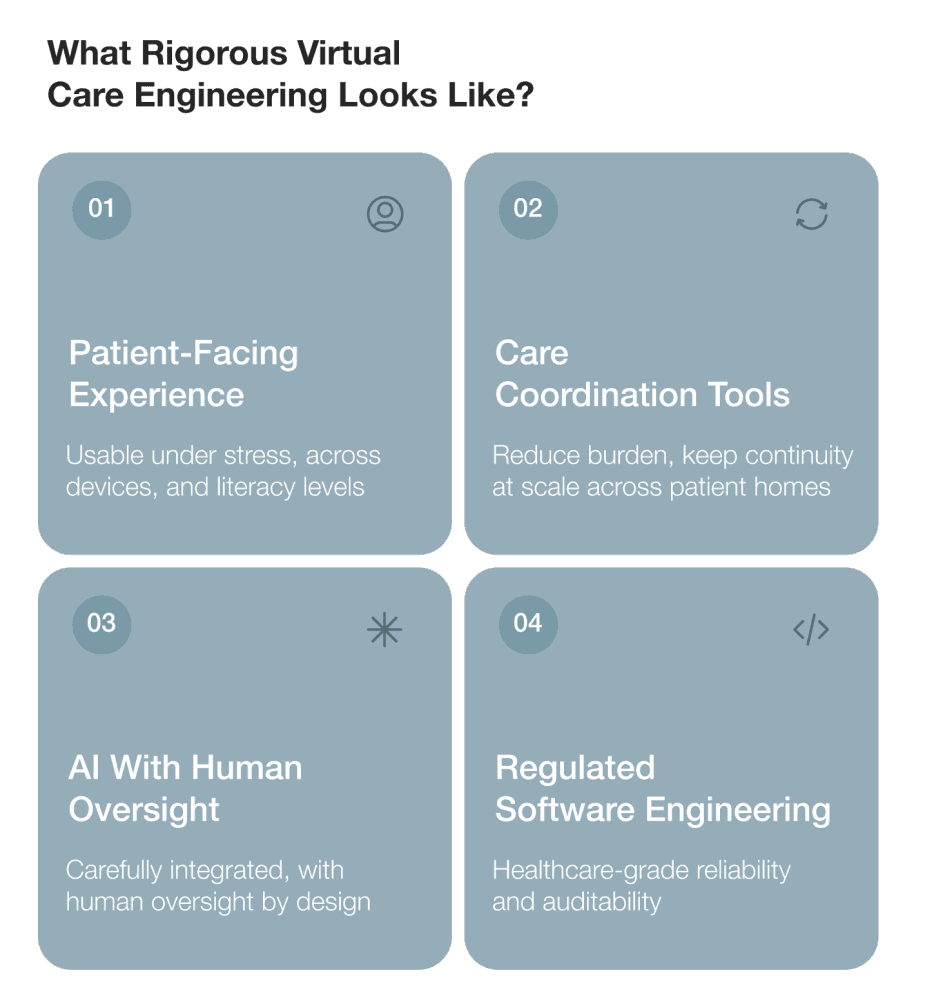
In practice, that means several things.
Patients and caregivers managing medications at home need interfaces that are genuinely usable under stress, across different devices and literacy levels. This shouldn’t look like a portal designed for a desktop-first hospital administrator. Getting that right requires serious investment in patient-facing experience design.
Care teams need tools that reduce administrative burden, not add to it. Connecting providers, patients, and coordinators through well-designed workflow systems is what keeps continuity of care intact when the ward is distributed across dozens of home addresses.
Carefully integrated AI can play a real, even a crucial role in triage support, workflow automation, and surfacing the right information to the right clinician at the right moment. In a regulated care context, “carefully integrated” means integrating AI with human oversight by design.
The underlying data architecture must be secure, interoperable, and capable of integrating clinical, operational, and patient-generated data without creating compliance risks or fragmented records.
And the software itself has to meet healthcare-grade standards for reliability, auditability, and long-term maintainability. Regulated software engineering is a product quality issue.
Virtual care is not a category that will shrink. Hospital-at-home and virtual ward programs give people the dignity of recovering in their own space, surrounded by their own life. They also give families and caregivers the ability to be present by staying close, not stranded in waiting rooms. For patients managing serious conditions, that matters in ways that go beyond clinical outcomes.
Precisely because these programs carry that kind of weight, the technology behind them has to be built with the same rigor and depth of knowledge that healthcare professionals bring to the bedside. Cutting corners on workflow architecture, interoperability, or compliance is a patient safety problem.